 Skip to content

A single missing document in a driver qualification file can fail a DOT audit. Not a stack of missing files — one. The driver qualification file, or DQF, is the record every motor carrier must keep for each driver who operates a commercial motor vehicle, and it is the first thing an FMCSA auditor asks to see. This checklist walks through every document required under 49 CFR §391.51 — what each one is, when it is due, and how long you have to keep it — so you can build a file that holds up. A free, printable version is waiting at the bottom of the page.
What Is a Driver Qualification File?
A driver qualification file is the collection of records that proves a driver is legally qualified to operate a commercial motor vehicle for your company. FMCSA requires one for every driver you employ, and the responsibility to build and maintain it sits with you, the carrier — not the driver. The rules live in 49 CFR Part 391, and §391.51 is the section that spells out exactly what the file must contain.
Think of it less as a folder and more as your evidence. If a violation, a crash, or an audit ever puts a hiring decision under scrutiny, the DQF is what defends it. A clean file is proof you did your job. A gap in the file is proof you did not.
Who Needs a Driver Qualification File?
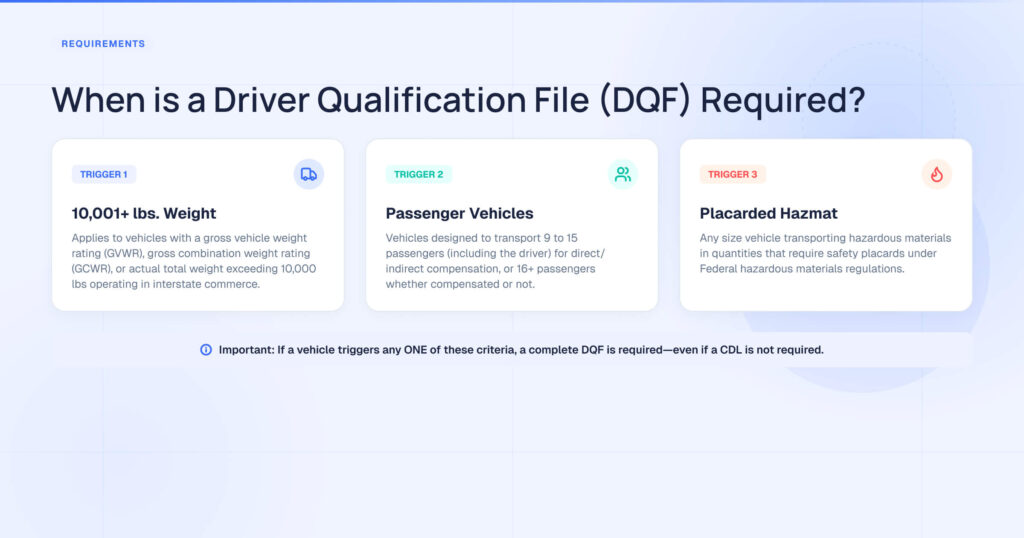
You need a DQF for every driver who operates a commercial motor vehicle in interstate commerce — and that is broader than most carriers assume. A vehicle is a CMV if it meets any of the following:
- A gross vehicle weight rating, gross combination weight rating, or actual weight of 10,001 pounds or more
- Designed or used to transport 9 to 15 passengers (including the driver) for compensation, or 16 or more passengers regardless of compensation
- Used to transport hazardous materials in a quantity requiring placards
If a driver meets any of these, they need a qualification file — even if they drive on a standard Class C license. The non-CDL exemption people assume exists does not.
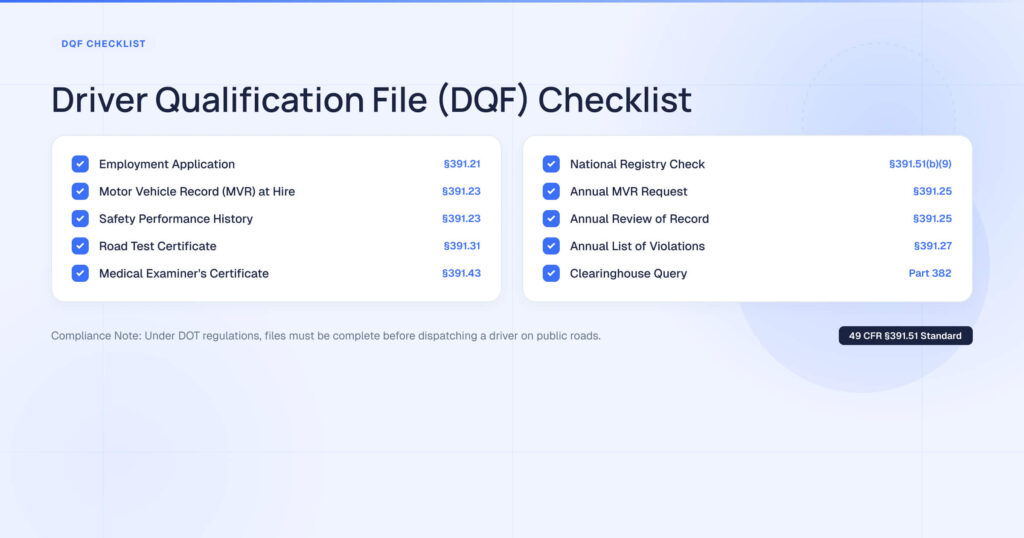
The Complete DQF Checklist — 10 Required Documents
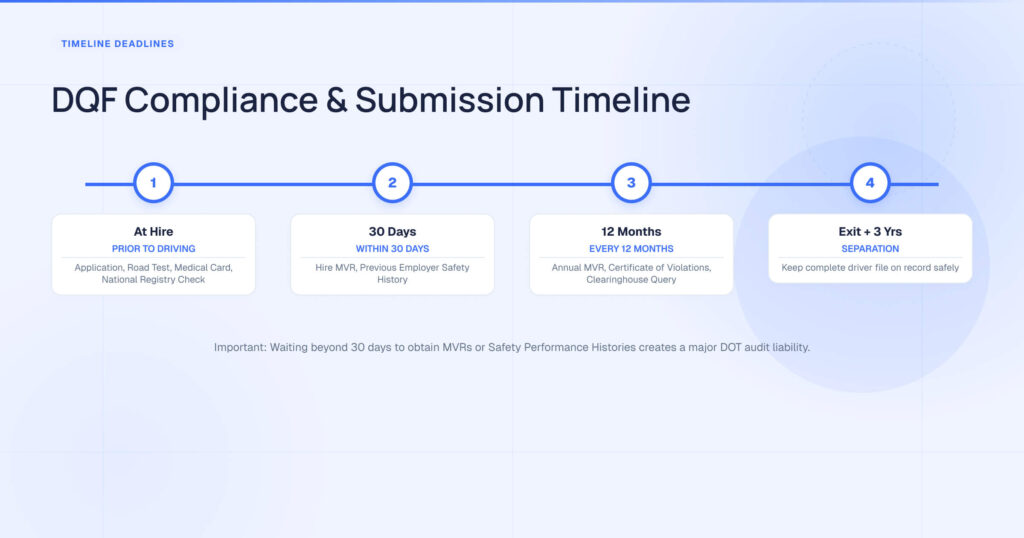
Each item below includes the governing rule and the deadline that matters most. Miss the deadline and the document counts as missing, even if it lands in the file later.
1. Driver’s Application for Employment (§391.21)
A completed DOT employment application covering the driver’s residence, the previous 3 years of employment history, license information, and any accidents and violations. This is the foundation of the file — every other document verifies what the driver declared here.
2. Motor Vehicle Record at Hire (§391.23)
An MVR pulled from every state where the driver held a license in the past 3 years. You must request it within 30 days of the driver’s start date. It confirms the license is valid and surfaces the driving history an applicant may not volunteer.
3. Safety Performance History — Previous Employer Investigation (§391.23)
For the previous 3 years, you must investigate the driver’s DOT-regulated employment: accidents, plus any drug or alcohol violations. Requests go to former employers within 30 days of hire, and the responses — or your documented good-faith attempts to obtain them — go in the file.
4. Road Test Certificate (§391.31)
A certificate showing the driver passed a road test in the type of vehicle they will operate. For most vehicle types you may accept a copy of the driver’s valid CDL in lieu of the road test — but not for double/triple trailers or tank vehicles, and not for non-CDL drivers who have no CDL to substitute.
5. Medical Examiner’s Certificate (§391.43)
The driver’s current medical card, issued by a certified medical examiner. As paper cards are phased out and results flow electronically through the National Registry, keep a copy of the current certificate and track its expiration closely. An expired medical card is one of the most common — and most avoidable — audit findings.
6. National Registry Verification (§391.51(b)(9))
A note in the file confirming you verified that the medical examiner who issued the certificate is listed on FMCSA’s National Registry of Certified Medical Examiners. A valid-looking card from an unlisted examiner does not count.
7. Annual Motor Vehicle Record (§391.25)
At least once every 12 months, pull a fresh MVR from each state where the driver holds a license. This is separate from the MVR you pulled at hire — it catches the violations that accumulate after a driver is already on your roster.
8. Annual Review of Driving Record (§391.25)
After pulling the annual MVR, you must review it to decide whether the driver still meets your qualification standards, then file a dated note recording that the review happened and who conducted it. The MVR without the documented review is only half the requirement — and auditors check for both.
9. Annual List of Violations (§391.27)
Each year, the driver must provide a signed list of all traffic convictions from the previous 12 months, parking excluded. If they had none, that is stated and signed too. Many carriers collect this at the same time as the annual review.
10. Drug & Alcohol Clearinghouse Query (Part 382)
For CDL drivers, run a pre-employment full query of the FMCSA Drug & Alcohol Clearinghouse before they drive, and a limited query at least once a year afterward. Technically this belongs to your drug and alcohol program under Part 382 rather than §391.51, but auditors expect to see it and most carriers keep the record alongside the DQF.
Quick-reference checklist
| Document | Rule | Key deadline |
|---|---|---|
| Employment application | §391.21 | At hire |
| MVR at hire | §391.23 | Within 30 days of hire |
| Previous employer safety history | §391.23 | Within 30 days of hire |
| Road test certificate (or CDL copy) | §391.31 | At hire |
| Medical examiner’s certificate | §391.43 | At hire; before expiry thereafter |
| National Registry verification | §391.51(b)(9) | At hire and each new med cert |
| Annual MVR | §391.25 | Every 12 months |
| Annual review of driving record | §391.25 | Every 12 months |
| Annual list of violations | §391.27 | Every 12 months |
| Clearinghouse query (CDL) | Part 382 | Pre-employment + annually |
DQF Checklist for Non-CDL Drivers
Drivers who operate a CMV without a CDL still need a qualification file — the weight, passenger, and hazmat thresholds above trigger the requirement regardless of license class. The file looks almost identical, with two differences worth flagging. First, you cannot substitute a CDL for the road test, because there is not one, so an actual road test certificate is mandatory. Second, CDL-specific items like the Clearinghouse query do not apply. Everything else — application, MVR, medical card, previous-employer history, annual MVR and review — stays exactly the same.
DQF Requirements for Owner-Operators
Being an owner-operator does not exempt you from the DQF — it means you keep a file on yourself. If you operate under your own authority, you are both the carrier and the driver, and FMCSA holds you to the same §391.51 standard as a hundred-truck fleet. If you are leased on to another carrier, that carrier usually maintains your file, but confirm it in writing. “I assumed they had it” is not a defense in an audit.
How Long to Keep Driver Qualification Files
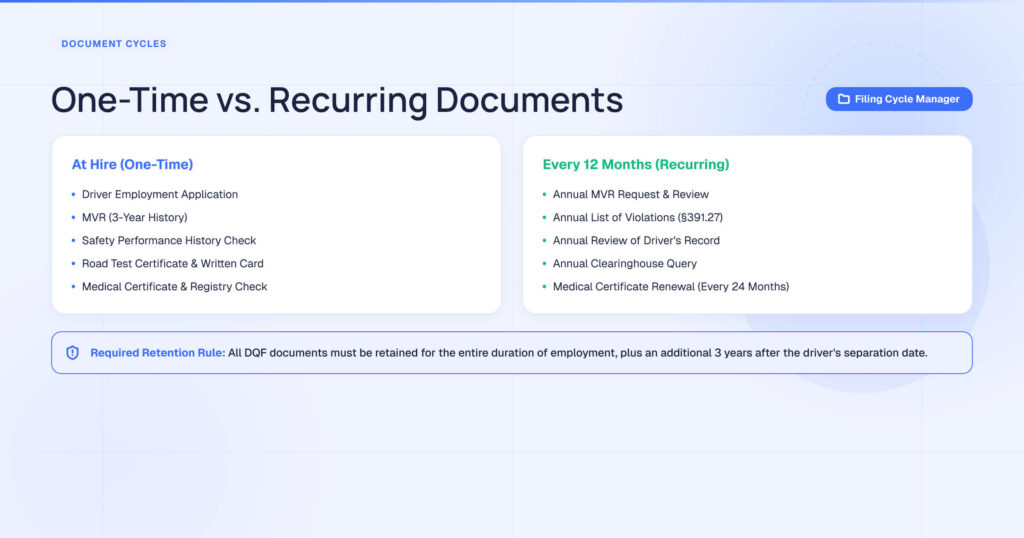
Keep the qualification file for as long as the driver works for you, plus 3 years after they leave. A few items run on their own clock: the annual MVR and the annual review of driving record must each be retained for 3 years from the date they were created. When in doubt, keep it longer. Storage is cheap. A gap in the record is not.
Download the Free DQF Checklist (PDF)
Here’s the whole checklist as a printable, one-page PDF — every document above, with the hire deadlines and retention rules laid out so you can print it and work straight down the list, one driver per file.
Build the File Once. Track It Automatically.
A paper DQF is a stack of documents that quietly expires. A medical card lapses, an annual review slips, and you do not find out until an auditor does. That is the problem DOTDriverFiles was built to solve.
We do not just store the documents — we read them. Upload a license and the system fills the file, tracks every expiration, and alerts you 90 days before a card, MVR, or review comes due. When an audit lands, you export a complete, organized file in seconds instead of digging through folders.
Frequently Asked Questions
What needs to be in a driver qualification file?
The employment application, an MVR at hire and again annually, the previous-employer safety history, a road test certificate (or a CDL copy in lieu), the medical examiner’s certificate, National Registry verification, the annual review of driving record, and the annual list of violations. CDL drivers also need a Drug & Alcohol Clearinghouse query.
Do I really need a driver qualification file?
If you employ anyone who drives a commercial motor vehicle — 10,001 pounds or more, placarded hazmat, or carrying passengers for pay — then yes, one file per driver, by federal law. There is no small-fleet exemption.
Where can I find the FMCSA driver qualification file in PDF format?
You can download our complete DQF checklist as a printable PDF using the form above. For the regulation itself, 49 CFR §391.51 is published on the FMCSA and eCFR websites.
What goes in a DOT compliance binder?
A DOT binder usually holds the driver qualification files plus your drug and alcohol testing records, vehicle maintenance files, the accident register, and hours-of-service records. The DQF is the driver-specific piece of that larger set.
How long do you keep a driver qualification file?
For the length of employment plus 3 years afterward. The annual MVR and annual review of driving record are each kept for 3 years from the date they were created.
Do non-CDL drivers need a driver qualification file?
Yes, if they operate a qualifying CMV. The main difference is that an actual road test certificate is required, because there is no CDL to substitute in its place.
What is required for an owner-operator’s DQF?
The same documents as any other driver. If you run under your own authority you maintain the file yourself; if you are leased on to another carrier, confirm in writing which party keeps it.
Is an electronic driver qualification file acceptable to FMCSA?
Yes. FMCSA accepts electronic records as long as they are legible, accessible, and reproducible during an audit. Electronic files also make expiration tracking far easier than paper ever will.