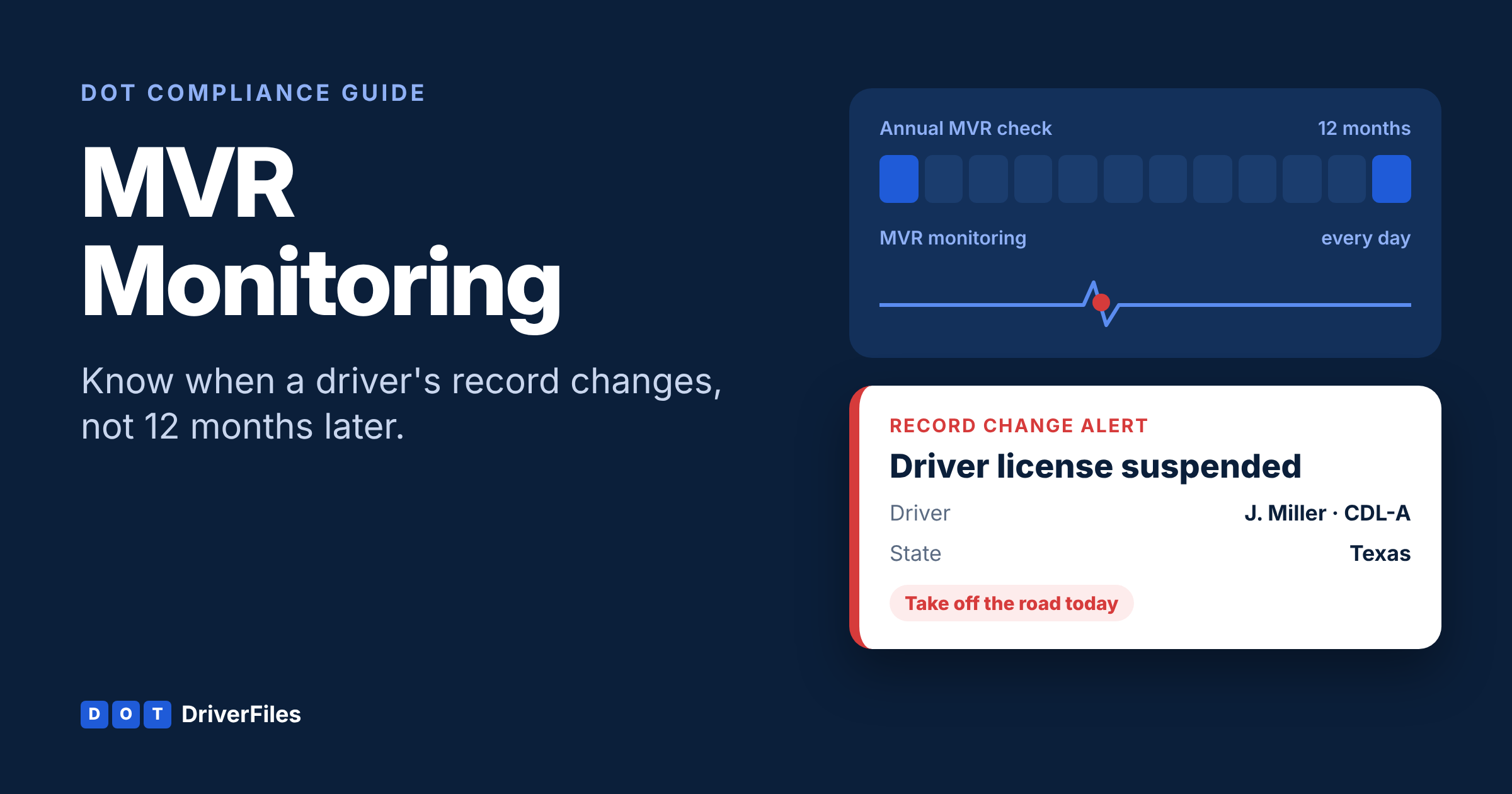
You pull a driver’s MVR when you hire them. Then FMCSA asks you to pull it again once every 12 months. That is the rule.
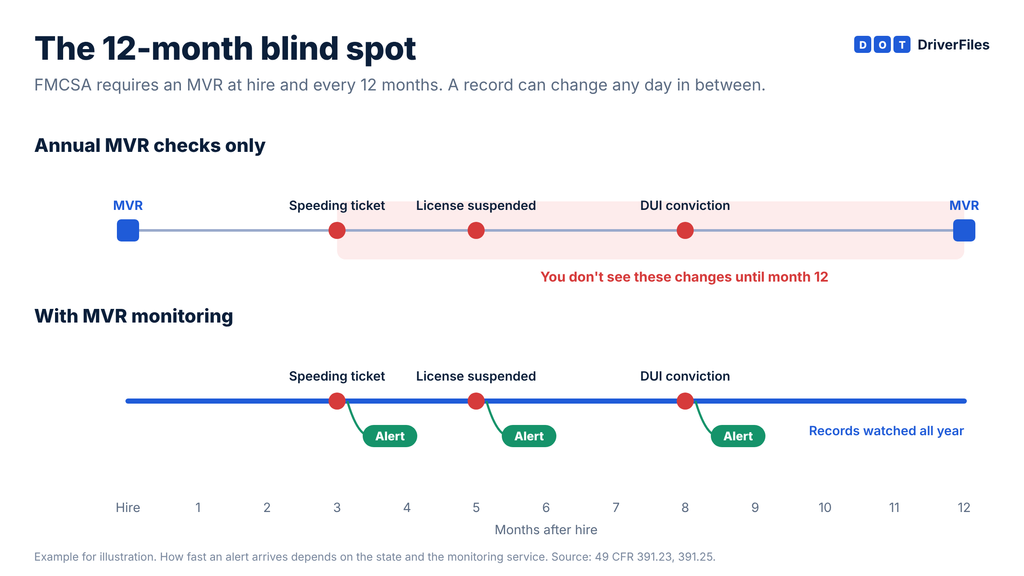
But a driver’s record can change on any day of those 12 months. A speeding ticket in March. A suspended license in June. A DUI in August. If the driver does not tell you, you may not know until the next annual check. Your truck is on the road with that driver the whole time.
MVR monitoring closes that gap. This guide explains what it is, what FMCSA requires, what it does not require, and how to set it up in your fleet.
What is MVR monitoring?
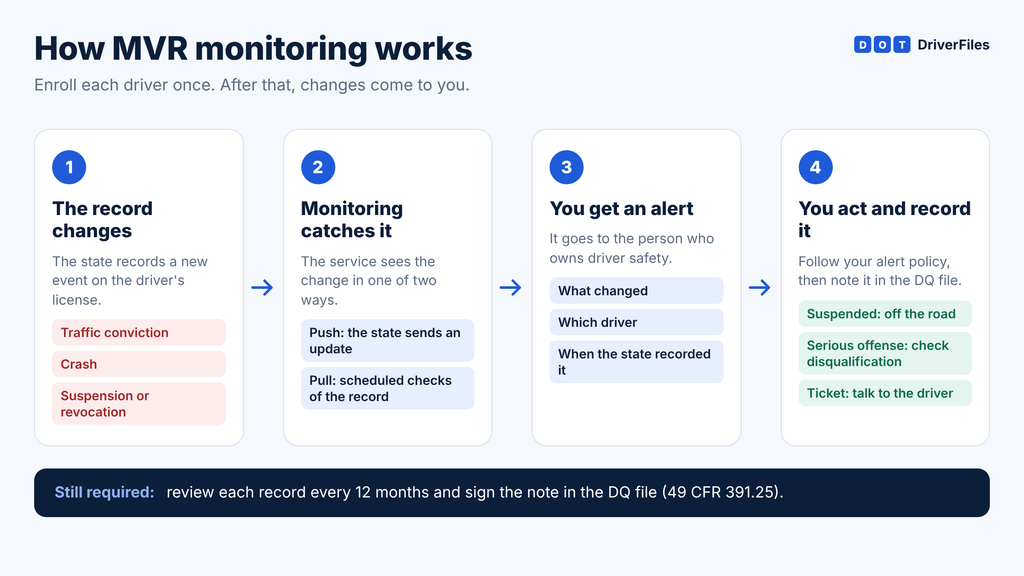
MVR monitoring is an ongoing check of your drivers’ motor vehicle records. You enroll each driver once. After that, the service watches the record and alerts you when something changes — a new violation, a crash, a suspension, a revocation or a disqualification.
A standard MVR is a snapshot. It shows the record on the day you order it. MVR monitoring is closer to a live feed. You learn about a change soon after the state records it, not months later.
There are two common types:
- Push monitoring. The state or the provider sends you an alert when the record changes. You do nothing until an alert arrives.
- Pull monitoring. The system checks each record on a set schedule, for example every month, and tells you what changed since the last check.
FMCSA uses the name “employer notification system” (ENS) for these programs, and it describes both push and pull versions. Some states run their own. California’s Employer Pull Notice program is the best-known example, and it is required for many California employers of commercial drivers.
What FMCSA requires (and what it does not)
FMCSA does not require MVR monitoring. It requires two MVR checks, and it allows monitoring as a way to do the second one.
1. Before hire — 49 CFR 391.23. Within 30 days of the driver’s start date, request the MVR from every state where the driver held a license or permit in the last 3 years. Put it in the driver qualification file. If a state does not answer, document your good-faith effort.
2. Every 12 months — 49 CFR 391.25. At least once every 12 months:
- Get the MVR from each licensing authority where the driver held a license in the past year.
- Review it. Decide if the driver still meets safe-driving standards or is disqualified under § 391.15. Give “great weight” to speeding, reckless driving, and driving under the influence.
- Keep a copy of the MVR in the DQ file, plus a note with the reviewer’s name and the review date.
Two changes from the last decade matter here:
- 2015: monitoring counts. In a regulatory guidance notice of March 12, 2015, FMCSA said an employer notification system that checks the record at least once a year satisfies the annual review requirement. That includes systems run by a third-party provider.
- 2022: the driver’s annual list is gone. A final rule effective May 9, 2022 removed § 391.27, so drivers no longer give you a yearly list of their violations. The annual MVR is now your main source. In that rule FMCSA called continuous monitoring “very effective tools to keep employers aware of changes.”
One thing does not change with monitoring: you still do the annual review. Someone must look at the record, decide, and sign the note in the DQ file.
Why once a year leaves you exposed
The annual rule assumes drivers tell you about problems between checks. Federal rules do require that from CDL holders:
- Convictions — 49 CFR 383.31. A CDL driver must tell the current employer, in writing, within 30 days of a conviction for any traffic violation (not parking), in any type of vehicle.
- Suspensions — 49 CFR 383.33. A driver whose license is suspended, revoked or canceled, or who loses the right to drive a CMV, must tell the employer before the end of the next business day.
In practice, these rules depend on the driver. A driver who fears losing the job may report late or not at all. A driver may not know a suspension started — for example, after a missed court date or an unpaid fine. And non-CDL drivers of DOT-regulated vehicles are not covered by these Part 383 rules at all.
So here is the real risk. Say a driver’s license is suspended 2 months after the annual check, and nobody tells you. That driver can run loads for 10 months on a suspended license before your next MVR shows it. If there is a crash in that time, the question in court is simple: could the carrier have known?
MVR monitoring cuts that window from up to 12 months to days or weeks. How fast depends on the state and the service.
Annual MVR checks vs. MVR monitoring
| Annual MVR check | MVR monitoring | |
|---|---|---|
| Meets § 391.25 | Yes | Yes, if the record is checked at least once a year (FMCSA 2015 guidance) |
| How you learn about a change | At the next check, up to 12 months later | An alert soon after the state records it |
| Depends on the driver reporting | Yes, between checks | Much less |
| Your work | Order, review and file each MVR every year | Enroll once, act on alerts, still do the annual review note |
| Cost | One MVR fee per driver per year | A monitoring fee per driver; varies by provider |
| Covers non-CDL DOT drivers | Yes | Depends on the state and the provider |
For a 3-truck fleet with long-time drivers, annual checks may be enough. Once you have more drivers, high turnover, or drivers with past violations, the gap between checks becomes the bigger risk.
Driver consent and state rules
MVR monitoring uses the same records as a normal MVR, so the same consent rules apply. Get them right before you enroll anyone.
- FCRA disclosure and authorization. When an MVR comes through a consumer reporting agency, the Fair Credit Reporting Act requires a clear written disclosure in a separate document, and the driver’s written consent, before you get the report. Employment lawyers advise asking for consent at hire that covers reports for the whole time the person works for you, not just the first report.
- Adverse action. If you plan to take a driver off the road or let them go because of something in a report, the FCRA has notice steps you must follow. Check them with your lawyer or your report provider.
- State programs. Some states run their own employer notification programs. In California, Vehicle Code §1808.1 requires employers of class A and B drivers, and some others, to enroll them in the DMV’s Employer Pull Notice program. The DMV then reports new convictions, accidents and suspensions to the employer. California employers must still get a report at least every 12 months.
This section is general information, not legal advice. Consent rules differ by state.
How to set up MVR monitoring in your fleet
- List every driver who needs an MVR. Include CDL drivers and non-CDL drivers of DOT-regulated vehicles. Note each driver’s licensing state.
- Update driver consent. Use a standalone FCRA disclosure and an authorization that covers reports during the whole time the driver works for you.
- Pull a fresh baseline MVR. Start from a current, clean picture of each record, and file it in the DQ file.
- Enroll the drivers. Use your provider’s monitoring service, and your state’s program where it is required (for example, California’s Employer Pull Notice).
- Write a simple alert policy. Decide who gets alerts and what each one triggers. For example: suspension or revocation → off the road the same day; DUI or other serious offense → check disqualification under § 391.15; speeding → talk with the driver and note it.
- Keep the annual review. Once a year, review each record and sign the note in the DQ file, as § 391.25 requires.
- Remove drivers who leave. Take them out of monitoring on their last day, so you only pay for active drivers and stop getting reports you no longer have a reason to see.
Stop finding out 10 months late
DOTDriverFiles already keeps your DQ files, tracks expiration dates, and lets you order MVRs in minutes. Driver Monitor is the next step: it watches each driver's record between your scheduled MVR pulls and alerts you when something changes.
Start free trial